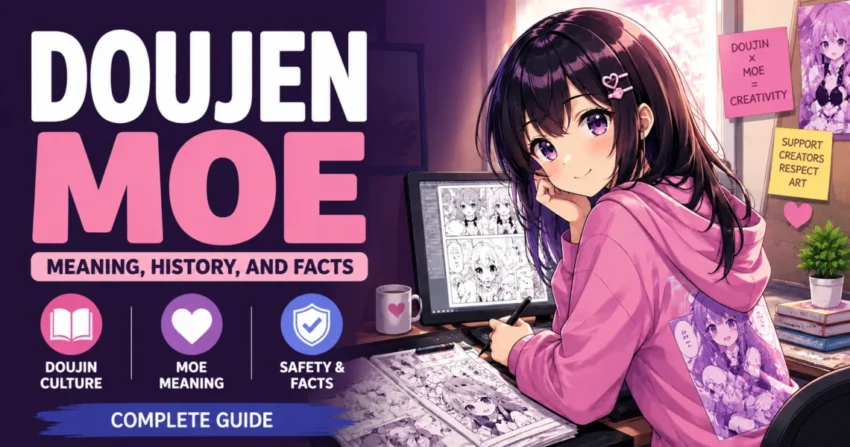
What Is Doujin.moe? The Ultimate Reader’s Guide to the Platform is a useful question for readers who have encountered the name while exploring anime, manga, and Japanese fan culture online. The term can be confusing because “doujin” has a well-established meaning in Japanese creative culture, while “Doujin Moe” has also been used as the name of an online platform. Recent online discussions sometimes blur these two meanings together.
For readers, understanding the distinction is important. Doujin refers broadly to independent or self-published creative works, while doujinshi commonly describes independently produced comics and similar publications. “Moe,” meanwhile, describes an emotional sense of affection or attachment toward fictional characters. The name Doujin.moe may therefore appear in discussions about both a website and the wider doujin community.
What Is Doujin.moe?
Doujin.moe has historically been associated with an online collection of doujin-related illustrated material. Older references to the name predate many recent articles that describe “Doujin Moe” simply as a modern anime art aesthetic. This distinction is important because a website name and a cultural term are not necessarily the same thing.
Current information about the platform should be treated carefully because websites can change ownership, content, advertising, policies, and technical operation over time. A domain being registered or reachable does not, by itself, establish that its current content, operators, or practices are the same as they were historically.
Understanding Doujinshi
To understand why the platform’s name is associated with manga, it helps to understand doujinshi. The word generally refers to independently published works created by individuals or small creative groups. These publications can include original stories as well as derivative works based on existing anime, manga, games, or other media.
Doujin culture is much broader than one website. Independent creators have traditionally distributed their work through fan communities, specialist events, physical publications, and digital services. Large conventions such as Comiket have played an important role in connecting creators with readers and fans.
What Does “Moe” Mean?
“Moe” is a Japanese fandom term associated with strong affection or emotional attachment toward fictional characters. It is often connected with qualities such as cuteness, charm, innocence, personality, or vulnerability. The word does not simply mean “anime” or “manga,” and it is not itself a publishing format.
This is why combining “doujin” and “moe” can create confusion. One word describes a broad creative or fan-publishing context, while the other describes an emotional or aesthetic quality. Some modern websites use “Doujin Moe” to describe fan-created work featuring moe characteristics, but that does not necessarily establish it as a formal Japanese genre.
How the Platform Relates to Anime and Manga Culture
Online doujin platforms emerged from a much larger ecosystem of fan creativity. Anime and manga communities have long encouraged artists and writers to create their own interpretations of popular characters and fictional worlds. Digital platforms made it easier for these works to reach international audiences.
This broader culture includes original creations as well as derivative fan works. Readers should therefore avoid assuming that every item described as doujin is an official publication. The creator, publisher, rights holder, and distribution method can vary considerably from one work to another.
Is Doujin.moe the Same as Doujinshi?
No. Doujinshi is an established term for independently produced publications, whereas Doujin.moe is a website name that has historically been associated with online doujin material. Treating the two as interchangeable can lead to an inaccurate understanding of both.
There is also a difference between the website and the broader concept of “doujin moe.” The latter can be used informally to describe independently created work with moe characteristics. The former refers to a particular online identity. Keeping these meanings separate makes research much clearer.
What Should Readers Know About Copyright?
Copyright is an important consideration when reading or sharing independently created fan works. Some doujinshi are completely original, while others use characters, settings, or concepts owned by third parties. The legal treatment of derivative works varies by jurisdiction, and informal practices within Japanese fan culture should not automatically be interpreted as universal legal permission.
Readers should therefore respect copyright and the terms established by creators and rights holders. Purchasing officially licensed material or supporting creators through legitimate channels is generally the safest way to ensure that artists and publishers receive appropriate support.
Is Doujin.moe Safe to Browse?
Readers should use normal online safety precautions when visiting unfamiliar websites. The fact that a website has existed for a long time does not guarantee that every advertisement, download, redirect, or third-party element currently associated with it is safe.
Avoid downloading unknown files, entering unnecessary personal information, installing unfamiliar software, or interacting with suspicious pop-ups. Keeping your browser, operating system, and security software updated can also reduce common online risks. Because website conditions can change, current safety should be evaluated independently rather than based solely on historical reputation.
Why the Name Creates Confusion
Search results for Doujin.moe can be particularly confusing because several different meanings have developed around the phrase. Some pages describe it as an online platform, while others treat “doujin moe” as a combination of independent fan creation and moe aesthetics.
Spelling variations add another layer of uncertainty. Searches for “Doujen Moe,” “Dojen Moe,” and “Doujin Moe” may lead to overlapping discussions even though “doujin” is the standard romanization associated with the Japanese term 同人. For readers researching the subject, checking the context of each source is therefore essential.
How to Approach the Platform as a Reader
If you encounter Doujin.moe while researching anime or manga, begin by identifying what you are actually looking for. You may be interested in the history of the website, the meaning of doujinshi, the concept of moe, or independent fan-created manga. These are related subjects, but they should not automatically be treated as identical.
It is also useful to distinguish between information about a website and information about the creators whose work appears online. A platform may provide access to material without being the original creator or copyright holder. Looking for creator attribution and legitimate sources can provide a clearer picture of where particular works originate.
The Broader Importance of Doujin Culture
Doujin culture demonstrates how fans can become creators rather than simply consumers. Independent artists and writers have used this ecosystem to experiment with storytelling, illustration, game development, music, and other creative forms. Some creators eventually develop professional careers after building experience and audiences through independent work.
The culture also illustrates how the internet has changed the relationship between creators and readers. Digital publishing allows niche communities to connect across national borders, while social platforms make discovery easier than ever. At the same time, questions surrounding copyright, attribution, creator compensation, and responsible sharing remain important.
Conclusion
What Is Doujin.moe? The Ultimate Reader’s Guide to the Platform is best answered by separating the website from the wider concepts associated with its name. Doujin refers to independent or fan-created creative culture, doujinshi describes independently published works, and moe refers to a particular emotional connection or aesthetic surrounding fictional characters. Doujin.moe has also historically been associated with an online platform, creating additional ambiguity around the term.
For readers, the most important approach is to verify current information, respect copyright, and use sensible online safety practices. Understanding the difference between a platform, a publishing tradition, and a fandom concept makes it much easier to navigate discussions surrounding Doujin.moe and Japanese fan culture.
FAQs
What does Doujin.moe mean?
Doujin. Moe has historically been used as the name of an online doujin-related platform. The phrase can also be interpreted more broadly by combining the concepts of doujin and moe.
What is doujinshi?
Doujinshi generally refers to independently published works, particularly comics or manga created by individuals or small creative groups.
What does “moe” mean in anime culture?
Moe describes a strong feeling of affection or emotional attachment toward fictional characters, often connected with appealing personality traits or character designs.
Is Doujin.moe the same as doujinshi?
No. Doujinshi is a type of independently produced publication, while Doujin.moe has been used as the name of an online platform.
Is all doujin content fan-made?
Not necessarily. Doujin works can be based on existing franchises or feature completely original characters, stories, and settings.
Is Doujin.moe an official manga publisher?
There is no basis for treating the platform name itself as equivalent to an official manga publisher. Readers should check the original creator and publication source for individual works.
Is it safe to visit unfamiliar doujin websites?
Readers should use caution with unfamiliar websites, especially regarding downloads, pop-ups, redirects, advertisements, and requests for personal information.
Why do people search for “Doujen Moe” instead?
“Doujen Moe” appears to be a spelling variation used in online searches. “Doujin” is the more established romanization of the Japanese term associated with this fan-publishing culture.