
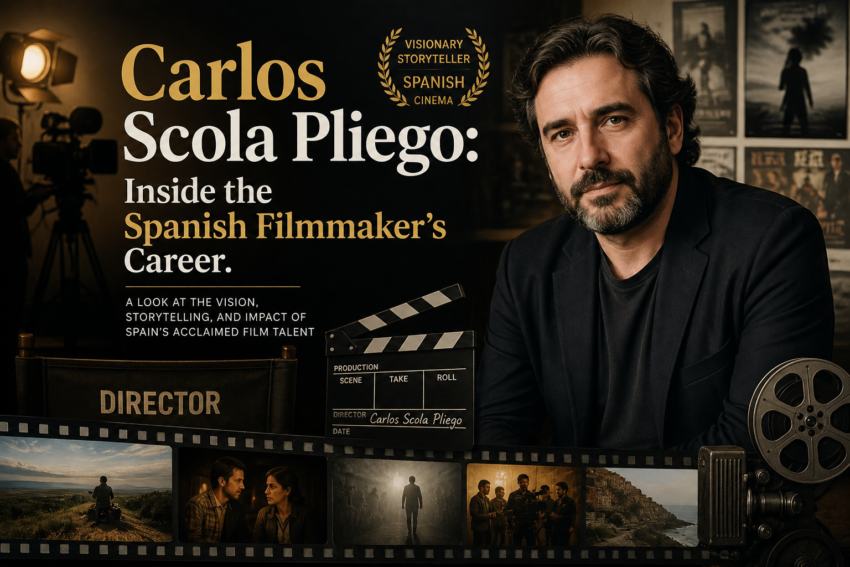
Carlos Scola Pliego: Inside the Spanish Filmmaker’s Career explores the professional journey of a Spanish filmmaker who built much of his career behind the camera. Although his name became widely known because of his marriage to British-Nigerian singer Sade Adu, Carlos had an established connection to the audiovisual industry before their relationship attracted public attention.
His documented career includes assistant-directing work, writing, producing, and directing. Film databases connect him with several Spanish and international productions during the 1980s, while later records associate his name with documentary projects and additional film work. Because Carlos has maintained a remarkably private public profile, some details about his personal life remain difficult to verify.
Who Is Carlos Scola Pliego?
Carlos Scola Pliego is a Spanish filmmaker whose professional name is also recorded as Carlos Scola. Available film records identify him in several behind-the-scenes roles, including assistant director, writer, producer, and director. His work demonstrates a career that developed through practical film-production experience rather than celebrity exposure.
His professional story is particularly interesting because he worked on productions connected with both Spanish cinema and international projects. Rather than becoming a recognizable on-screen personality, he remained primarily part of the production teams responsible for bringing films and television projects together.
Early Career Behind the Camera
Carlos’s documented professional journey includes work in production during the late 1970s and early 1980s. Film records associate him with script and continuity work before he moved into assistant-directing positions. These early responsibilities gave him practical experience with the organisation and technical demands of film production.
His credits include work on projects such as Opera Prima, Dos y dos, cinco, Black Commando, Hundra, G’olé!, Scarab, Never Say Never Again, and Curse of the Pink Panther. Some of these positions were uncredited, so they should be distinguished from roles officially displayed in a film’s on-screen credits.
Work on International Productions
One of the most notable aspects of Carlos’s career is his involvement with international productions filming in Spain and elsewhere. His assistant-director work demonstrates that his experience extended beyond small domestic projects and placed him within larger production environments.
He was also credited as assistant director for Spain on the 1985 television miniseries Christopher Columbus. The production records specifically list him as “assistant director: Spain” under the name Carlos Scola, with the full name Carlos Scola Pliego shown in the credit.
Moving Into Directing and Documentary Filmmaking
Carlos eventually moved beyond assistant-directing responsibilities and took on creative roles as a director and writer. Two particularly important projects associated with him are Ngira: Gorilas en la montaña and Donde termina el corazón.
Film records list Ngira: Gorilas en la montaña as a 1988 short for which Carlos received directing and writing credits. He is also associated with Donde termina el corazón, released in 1989, as director and writer. These projects provide the clearest evidence of his development from production professional into filmmaker with his own creative work.
His Interest in African Subjects
The documentary projects associated with Carlos are particularly notable because of their focus on Africa. Ngira: Gorilas en la montaña explored gorillas in a mountainous African setting, while Donde termina el corazón was connected with broader African locations and subjects.
These works suggest an interest in documentary filmmaking and real-world subjects rather than conventional commercial storytelling alone. However, there is limited publicly available material explaining Carlos’s creative philosophy, production methods, or personal motivations, so it is better to focus on his documented projects than speculate about his artistic intentions.
Carlos Scola Pliego and Sade Adu
Carlos’s name became much more recognizable after his relationship with Sade Adu. According to EL PAÍS, Carlos was working as an assistant director on three audiovisual pieces associated with Sade around 1985, when he was establishing himself in Madrid’s audiovisual industry. Their professional connection later developed into a personal relationship.
Sade’s official biography confirms that she married the Spanish film director Carlos Scola Pliego in 1989. The relationship became an important part of his public biography, even though his own professional career existed independently of the marriage.
Marriage and Private Life
Carlos and Sade married in 1989 during a period when Sade was already an international music star. EL PAÍS reports that Sade spent significant time in Madrid and that Carlos accompanied her during the period surrounding the recording of Stronger Than Pride. The publication also describes their marriage as taking place in October 1989.
Their marriage did not last permanently, and secondary records generally place the divorce in 1995. However, relatively little reliable information exists about the circumstances surrounding their separation. Carlos has remained private, and there is no substantial first-person public account from him explaining the relationship or its ending.
Later Career and Public Record
Information about Carlos’s professional life after his best-documented 1980s work becomes considerably more limited. IMDb records connect him with additional crew work on Goal II: Living the Dream in 2007, although the listed role is dialogue coach rather than director or assistant director. This distinction is important when describing his later filmography.
There are also occasional online claims about other professional activities, but not all of them can be independently verified. For that reason, a reliable profile should distinguish established film credits from claims repeated across entertainment websites. His strongest documented identity remains that of a Spanish filmmaker who worked across several production roles and directed documentary projects.
Why Carlos Scola Pliego Remains a Private Figure
Unlike many people connected to internationally famous entertainers, Carlos has largely stayed away from public attention. There are few widely available interviews in which he discusses his career, creative influences, relationship with Sade, or personal life.
That privacy has created gaps in his biography. His exact birth date, education, current professional activities, financial situation, and present-day lifestyle are not reliably established through strong public sources. Rather than filling those gaps with speculation, it is more accurate to acknowledge that much of his life remains outside the public record.
Carlos Scola Pliego’s Lasting Career Legacy
Carlos Scola Pliego’s career is best understood through his work behind the camera. He developed experience in script and production roles, progressed into assistant directing, participated in international productions, and eventually directed and wrote documentary projects.
His association with Sade Adu undoubtedly increased public interest in his name, but it should not overshadow his own professional accomplishments. The surviving film records show a filmmaker who built practical experience across multiple departments and eventually created projects of his own. His career is therefore an example of how filmmaking can involve many different creative and technical roles beyond the person whose name appears on a movie poster.
Conclusion
Carlos Scola Pliego’s story is more than a celebrity relationship. His documented career shows a Spanish audiovisual professional who worked through several behind-the-scenes positions before moving into directing and writing. His credits across Spanish and international productions, followed by documentary projects such as Ngira: Gorilas en la montaña and Donde termina el corazón, provide a useful picture of his professional development.
His marriage to Sade Adu brought considerably more public attention, but reliable sources also show that Carlos had established himself in filmmaking before that relationship became widely known. Because he has maintained a private life, many personal details remain unconfirmed. The most accurate account is therefore one that focuses on his documented film career while avoiding unsupported claims about his age, finances, family, or present circumstances.
FAQs
Who is Carlos Scola Pliego?
Carlos Scola Pliego is a Spanish filmmaker known for assistant-directing, directing, writing, and production work in Spanish and international audiovisual projects.
What films did Carlos Scola Pliego direct?
His documented directing credits include Ngira: Gorilas en la montaña and Donde termina el corazón.
Was Carlos Scola Pliego married to Sade Adu?
Yes. Sade’s official biography confirms that she married Spanish film director Carlos Scola Pliego in 1989.
Did Carlos work on international productions?
Yes. His filmography includes assistant-directing work connected with several international productions, including Never Say Never Again and the Christopher Columbus television miniseries.
What is Carlos Scola Pliego best known for?
He is known both for his filmmaking career and for his former marriage to Sade Adu. His professional work includes assistant directing, writing, producing, and documentary filmmaking.
Did Carlos Scola Pliego work with Sade before their marriage?
Yes. EL PAÍS reports that he worked as an assistant director on three audiovisual pieces associated with Sade around 1985, before their marriage in 1989.
Is Carlos Scola Pliego still making films?
There is not enough reliable recent information to confirm his current professional activity. His later documented film-related record includes an additional-crew credit on Goal II: Living the Dream in 2007.
What is known about Carlos Scola Pliego’s personal life today?
Very little has been reliably documented. He has maintained a private profile, and claims about his current residence, finances, age, and lifestyle should be treated cautiously unless supported by authoritative sources.